English is a remarkable language. I’m proud to call it mine own. I’ve studied and loved many tongues, but for my money, none can touch the sheer joy of English. It’s so filled with idiom and rule-breaking grammar that it’s very difficult for foreigners to learn; French is a cake walk in comparison. Personally, I think only Mandarin Chinese is harder. That’s due to its diverse sources, for it is not merely a Romance language built upon Latin, as are French and Spanish. Born and bred in Britain, it began with the Sanskrit Indo-European language of the island’s Celts, then absorbed Latin from its Roman conquerors, (as well as from later Church Latin). Next came the waves of Germanic and semi-Germanic invaders, the Angles, the Jutes, the Old Norse, the Frisians, the Saxons, all from that same vast area of the Netherlands and its off-islands, Denmark, Germany, Jutland, etc. Finally came the last major conqueror, the Norman French, who tried to ban the Anglo-Saxon tongue altogether and failed, nevertheless leaving their Romance-language mark.
Accordingly, English is considered to be the largest language in the world, with over 500,000 words, and this exclusive of 20th century scientific and technical terms.
Being a complete nutcase on the age of sail, (which makes sense for a pudgy and pasty native of a landlocked state) I’ve always been a fan of Joseph Conrad. I read my first one,
Lord Jim, at the age of fourteen. (And the film version with Peter O’Toole is a pip.) Conrad’s works, from novels like Nostromo to short stories and novellas like
Heart of Darkness, upon which Coppola based the film Apocalypse Now, are all priceless treasures of our linguistic heritage. Along with using the sea so effectively as a psychological metaphor, his works were known above all for the beauty of their language.
But there was much I never knew about the man himself until many years later. I always loved telling this story to adult students struggling with English. Joseph Conrad was, in fact, born Jozef Teodor Konrad Korzeniowski in Poland in 1857. As a child, his father was sent into exile in Siberia for his political views, so as a boy must have picked up a little Russian. But in truth he only spoke Polish, and later French, which he learned as a young man when he went to school in Switzerland, and then to sea from the port of Marseilles. He read the great works of fiction in these two languages. At the age of 21 he skipped out of the French merchant marine and into the British one, at which time he had only a few words of English. He served in the British merchant marine for another 16 years, where he slowly picked up the language, not as a scholar, but as a seaman. He became a British subject in 1886. His experiences sailing in Indonesia and the Congo would color all of his work. But the astonishing thing is that he didn’t publish his first stories until the age of 37 - in English. None of these books were translations from his native Polish, or French. Conrad wrote in the language he learned last, and last of all. So much for old dogs and new tricks. He always said that he loved English for its myriad subtleties, for the fact that there were more ways to say the same thing in English than in any other language.
How right he was. An English thesaurus is three times as long as a French one. There are more ways to express the same idea in English than in any other language I know. And, even better for a writer, these various words often have oh-so-subtle differences in meaning. You can hate a guy. But you can also despise him, detest him, abhor him, loathe him and abominate him, as well as holding him in contempt, finding him odious, or bearing him a grudge. Not to mention the fact that he just plain pisses you off. And this only scratches the surface of how revolting, galling, irksome, obnoxious, despicable, repugnant, base and ignoble you find him.
Sorry. Started to sound like a politician there for a minute.
The symphonic tones of English run the gamut from the explosive 1812 Overture to the delicate minor keys of Chopin, from the lyrical beauty of Emily Dickenson, (
Because I could not stop for death, he kindly stopped for me / The carriage held but just ourselves, and immortality) to the talkover excitement of a battlefield scene in an MGM war picture or the rat-a-tat dialog of an early thirties talkie: Nothing matches the elasticity, the vibrancy, and the sheer sensuous pleasure of English.

So why is that, of all the bounty to be had from this tongue of poets and kings, the word that will be written across our tombstone ten thousand years hence is, without doubt,
“Fuck?” Of course, it would be hard to overstate the impact of English all over the world, far and above the influence of any single word - it is definitely our lingua franca, the world’s common tongue, a term that dates to the old days of the Mediterranean sea trade, when the seamen came up with a patois of their own that included elements of Spanish, Arabic, Italian, French, etc., so these traders could understand one another. It is now English that is spoken all over the world. Though I’ve become convinced that the “ugly American” tourist is pretty much of a myth (we tip big, we’re polite as hell, and we take a lot of crap), the fact is that one of their legendary statements, along with “That American green’ll spend anywhere!” is quite true - “They all speak English, you know, even if they pretend they don’t.”
We’re lucky, and we’ve traveled a great deal. I’d heard English the world over, but I think it was when I was in China that I really began to see the impact of it all. As in India, there are literally dozens of dialects there, and, as in India, they can’t always understand one another. This is why the nation of India had the good sense to make English their official language of government, while still working to protect every native dialect. In China, we learned a set of hand gestures in order to shop the bazaars and the hysterically misnamed Friendship Store, a department store for foreigners mainly to buy cheap silk pajamas. These hand gestures are the ones they use with one another when there’s a dialectic wall of stone between them.
But, in a nation cut off from the West for so many years, what surprised me most was the number of Chinese people I heard speaking English to one another. For two Chinese guys from different regions, English, even broken English, was often the only common language they shared.
And the fact is, the English foreigners speak better than any other, apart, perhaps, from “Are you ready to order,” is English profanity. As it rises over the traffic noise of Paris or floats above the cheering masses of soccer fans in Istanbul, the single word or’whelms all others, a constant reminder of America’s international impact: Fuck you, fuck all (a newer British noun; Brits love turning verbs into nouns, and vice-versa - have a “lie-down,” or, “Speak up! I’m Hoovering!”), fuck this and that and the other, and by the way, fuck off. Unbelievable.
In the Latin, sex was either concubitus or coitus, both of which survive only in scholarly or medical phrases. “Fuck” has a far earthier paternity.
According to my most treasured possession, the entire twenty-volume set of the
Oxford English Dictionary (
Praised Be Its Name), “fuck,” often spelled “fucke,” goes back in printed form to at least the 16th century. It is doubtless far older. And the OED (Praised Be Its Name) points out its usage in various classic works, from Burns to Lawrence.
According to another favorite source,
A Classical Dictionary of the Vulgar Tongue, by an antiquarian named Captain Francis Grose, who wrote it to make the unintelligible cant slang and profanity of the London streets understandable to the educated who were being vilified without realizing it. (Though he, of course, cautions them not to actually use it.) Originally published in 1785, with several new editions and copious notes in modern editions by Eric Partridge, it speaks of the word’s many 15th century companions, including the very Shakespearean “swive,” then mentions a possible Latin root in
futuere, or the Greek
phuteuo, neither of which are in my squeaky clean dictionaries, as well as the gentle French root
foutre. Another dictionary describes the Roman root as “psuedo-Latin,” whatever that is, probably slang, the word being fuccant. But I think he really gets to the point when Partridge mentions briefly a Teutonic root for the central consonant “c”.
And the Oxford English Dictionary (
PBIN) gets there eventually as well, mentioning briefly the Germanic root word fuken.
Here, I think, the scholars have hit the mark, though they may have missed its import. I’m no fan of German, but I believe it was the addition of that jarring consonant at the center that turned the word from one of many to a stand-alone classic. It’s the onomatopoeic aspect of the thing, the simple impact of its sound as it falls upon the recipient’s ear. I suppose it’s that touch of German in our glorious tongue that gives the word that harsh and discordant flair. I must admit, as much as I love French, my Christopher is right - when your house is burning down, it just doesn’t have the same impact to be mincing around shouting,
“Feu! Feu!” “Fuck” also has an astonishing, nay an endless number of variants. I think that most people, no matter how potty-mouthed, have a particular vulgarity they hate. For me, it’s the disgustingly Oedipal M-F word, the coarse hyphenate every rapper loves even more than Keats loved his Grecian urn. I shall not sully my electronic pen to repeat it even here in this free-wheeling gallery of the fun and profane, for I will play no part in giving it any legitimacy, nor will I provide it an audience.
This does not mean, however, that I have no romance with profanity, in all languages. Our swear words tell us as much about ourselves as do our art museums and our bathrooms. Or, as a proud British bellboy, showing me the power of the flush and the showerhead in our hotel room once said, “Great, isn’t it? I know how you Yanks love your plumbing.”

Us Yanks love our swear words, as well. Perhaps a tad too much, truth to tell. The film
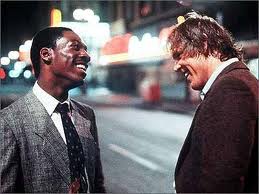
48 Hours with Nick Nolte and Eddie Murphy was a wake-up call for me. It came out while I was in film school. My mother had already taken note of the fact that hanging out with film students all the time had not improved my vocabulary. I was swearing more than I ever had in my life in those days, a habit I have since curbed. It’s like not turning up the radio when your hands are wet. You do things for your mother.
At any rate, in my opinion, the movie
48 Hours was a turning point in American film culture, such as it is. I never missed a movie in those halcyon days, and cinema by that time was pretty raw. Yet, even as I worked on film sets and cussed like a sweaty stevedore,
48 Hours got under my skin. It seemed more than merely profane; it was almost like a physical assault. There were times I wanted to get up and leave the theatre; my eardrums could simply stand no more.
In those pre-Internet days, we used to go to the
American Film Institute Library in order to read the great scripts and study them.
As we left
48 Hours, I glanced at Chris and said, “Wouldn’t you love to see the screenplay? Maybe we could find some of the dialog.”
Of course,
48 Hours has since been left in the dust by film after film that used profanity as a substitute for imagination. Now, it seems almost quaint. Although it is even more comical to see a channel that edits for language trying to run the thing; there are so many bleeps it sounds like a car alarm going off in the parking lot. It reminds me of ABC’s infamous airing of its fifty-seven minute version of
Midnight Cowboy. I never even got the fact that Jon Voight was a male prostitute.
And though we’ve both noticed a fresh new trend in a lot of American films, this being a bit of talent in the screenplay, the fact remains that, all in all, American movies that aren’t period pieces are just drowning in profanity, until you tune it out, you just don’t hear it anymore. Well, I still hear it, but I’m from out of the Stone Age.
And yet, I repeat, I’m not especially anti-profanity. When I’m tutoring a kid, I tell him he can use any profanity he wants. So long as he is able to give me the complete derivation of the word, including its original tongue and its complete conjugation, as well as noting the Latin or Greek derivatives. It seems to be a worse punishment than the paddle.
In Monty Python's
The Life of Brian, I am reminded of one scene in particular. All the Jewish freedom fighters are saying "What have the Romans ever done for us?" Unfortunately, they slowly start raising their hands and mentioning things. By the end, an exasperated John Cleese shouts,
"All right, but apart from the sanitation, medicine, education, wine, public order, irrigation, roads, the fresh water system and public health, what have the Romans ever done for us? "I always think of that scene whenever someone accuses America of being “imperialist.” We’ve given the world all of the above and more, collecting no tax from them as the Romans did, and by the way not crucifying them. The fact that people from Kiev to Marseilles love Levis jeans and Coca Cola does NOT make us an imperialist nation, except, perhaps, a passive one. We’ve given people all over the world clean water, food in famines, new methods of agriculture, AIDS-fighting programs that have saved untold millions of lives, troops to drive out the Hun, and just plain handouts and goodies galore.
Yet, it seems that, in the historical sense, the most universal thing we’ve given the world as a whole is the word “fuck.”
As with the remains of the Roman empire to be found in the ruins of Epheasus or Bath, when archeologists dig up what’s left of our American empire, they will doubtless note the well-worn path of this single epithet. In moments of rage or frustration, I have heard it issuing forth, virtually free of an accent, from the lips of Egyptian hack drivers, Greek waiters, Turkish policemen, Provencal waiters, Venetian gondoliers, Chinese bureaucrats, British mystery writers, Arab souk proprietors, Mexican pilots and Italian grand prix drivers. (Or cab drivers; in Italy, it’s hard to tell the difference.) They use it in all of its variants and tenses, as noun, verb and adjective, in both the active and the passive voice, as well as the imperative “fuck off.” You hear it a lot in Paris; the French version, foutre, just doesn’t seem to carry the same weight. You still hear it, but they seem to be pretty much abandoning it, as we’ve abandoned “Gee, whiz.”
What is it about the sound of the word, what is it about the look of it scrawled across a bathroom wall, what is it about the mystical, emphatic one-note impact of it, that has made it so cherished the world over, deathless even in an age of incessant and constantly shifting vulgarity?
My mother used to say that swearing is a sign of ignorance of a broader vocabulary. Though she was, of course, always right, in this one little thing I’m not certain I completely agree. No matter how eloquent the speaker, there are some check-bouncing, meat loaf-burning, finger-caught-in-the-car-door moments in life for which the eruption of “Fuck!” is the only word in the English language that can truly express the furious knot of rage in the stomach. And I use the word “express” as a verb here in both its meanings, for it almost seems to help rid your body of the tension of your fury, like a miniature exorcism, as if some of the frustration within is expelled in a “whoof” of sharply-consonanted air.
But be they physical or emotional, whatever its charms to those of every class, race and level of IQ, the word isn’t going anywhere. In a recent column by one of my favorite brainiacs, John Derbyshire, he told of the corps of Russian sleeper agents in America finally caught by authorities, and of the various Americanized monikers they were hiding behind. He then mentions the fact that the only bizarre name in the whole bunch belonged to a finance professor at the University of Washington commenting on the story who had taught many of them in his class, this being one Ufuk Ince.
The word simply will not lose its ability to entertain. Thank God I was home in my comfy chair, where I could laugh all I wanted, as I was inevitably reminded of a party I attended a few years ago, when an affable gentleman stuck out his hand to me with a beaming smile and chirped, “Hi! I’m Dick Bender!” I finally had to slink off to the Ladies Loo in order to get it out of my system before I could face him again. It was still tough. Wouldn’t you just call yourself Richard?

BTW, if you want to see a film that expresses the incessant ebb and flow of ever-changing slang, over
48 Hours I'd recommend
Ball of Fire, from 1942. Despite the millions of women who swooned at the mere mention of Gary Cooper’s name, he’s never been a favorite of mine. People don’t realize how popular a sex symbol he was; they say that part of the reason the HUAC committee finally got shot down in flames with the public was when they questioned the patriotism of the United States Army and Gary Cooper. The great costume designer Irene, a friend of Coop’s, jumped out of a hotel window after slashing her wrists when he died; she’d secretly loved him for years. Still, whether he turns you on or not, he’s not everyone’s idea of a mousy professor. And my very favorite actress of all time, Barbara Stanwyck, isn’t everyone’s idea of a femme fatale. But together, in this riotous Howard Hawks classic, they’re dynamite. Look for Elisha Cook, Jr. in a bit part as a hep-cat waiter - “She’s root, zoot and cute, and solid to boot.” At least he doesn’t get shot, again. The script, by the best of the best, Charles Brackett and Billy Wilder, is a masterpiece, a Valentine to American slang, which had reached its absolute apex during and after World War II. Sample dialog: When Stanwyck describes her supposed sore throat, she says “Are you kidding? It’s redder than the Daily Worker and twice as sore.” It’s all so rapid-fire, you may have to screen it more than once to catch them all. Don’t miss this one, even if you haven’t got a romance with the English language. Pass the popcorn.
And for a perfectly scholarly explanation of the work fuck,
have a look at this animation (possibly with the volume turned down), which sounds astionishingly like the Oxford English Dictionary (PBIN) entry.